A delivered unit can look clean and pressurised while carrying the wrong powder, hidden transport damage or no traceable service history. By following a fixed receiving sequence, you can verify the model, charge, condition and documents, then quarantine defects before the extinguisher reaches an industrial site in Hosur.
Key takeaways
- Photograph carton damage before opening the package.
- Check the cylinder, valve, hose, pin, seal, label and base in sequence.
- Compare the extinguisher’s weight with its recorded filled weight.
- Quarantine defects and document evidence before requesting replacement or resolution.
Start with the carton and identify the correct extinguisher
Before opening the carton, photograph crushed corners, torn strapping, wet patches, powder residue and punctures. Record signs of a drop, including a shifted cylinder, impact marks, a distorted base, or damage where the hose and valve were packed. This is the first step in an ABC 9 kg extinguisher inspection.
After unpacking, compare the purchase order and invoice with the cylinder label, nameplate and agent details. Confirm each item in this fire extinguisher delivery checklist:
- The agent is identified as ABC dry chemical powder, not merely “dry powder”.
- The nominal net agent charge is 9 kg. This is the powder quantity, not the fire rating.
- The model, manufacturer, extinguisher type, and printed Class A and Class B performance ratings match the order.
- The serial or batch number, manufacture date, gross mass where marked, pressure-test or hydrostatic-test date, and service or filling record are recorded.
| Evidence | Accept | Reject |
|---|---|---|
| Product marking | ABC dry chemical powder and 9 kg charge | “Dry powder” only or a different charge |
| Performance | Printed Class A and Class B ratings match the order | Missing or different ratings |
| Compliance | IS 15683 edition plus licence or marking details traceable to the unit | Generic certificate with no unit match |
Request conformity evidence tied to that serial or batch number. A certificate that cannot be matched to the physical extinguisher is insufficient.
Inspect every external component in a fixed sequence
Place the ABC 9 kg extinguisher upright on a stable surface. Accept it only when the cylinder, valve, hose, nozzle, gauge and label are intact, traceable and suitable for service; this is the essential ABC extinguisher condition check.
1. Inspect the shell, welds, neck and base. Reject dents, bulges, cracks, deep corrosion, pitting, leakage, damaged welds, damaged threads, repainting or a distorted base.
2. Examine the valve for impact damage, leakage and powder residue around the outlet. Move the operating lever gently; it must operate normally. Confirm that the safety pin is correctly seated and the tamper seal is unbroken.
3. Run your eyes and fingers along the hose from end to end. Reject cuts, flattening, loose fittings or kinks. Look through the nozzle for blockage, then check that its threads or retaining clips are secure.
4. Inspect the pressure-gauge lens and dial. The needle must sit in the marked green operating zone, not in red or outside the scale. A green reading does not prove that the powder charge or discharge path is correct.
5. Read the entire label. Confirm operating steps, fire-class pictograms, ABC agent information, precautions, rated performance, manufacturer or service identification, and recharge or maintenance instructions. Reject an unreadable label even when the metalwork looks sound.
Do not discharge the extinguisher, remove the valve or open the cylinder to inspect the powder. Quarantine any failed unit instead.
Use records and weighing to verify what the gauge cannot show
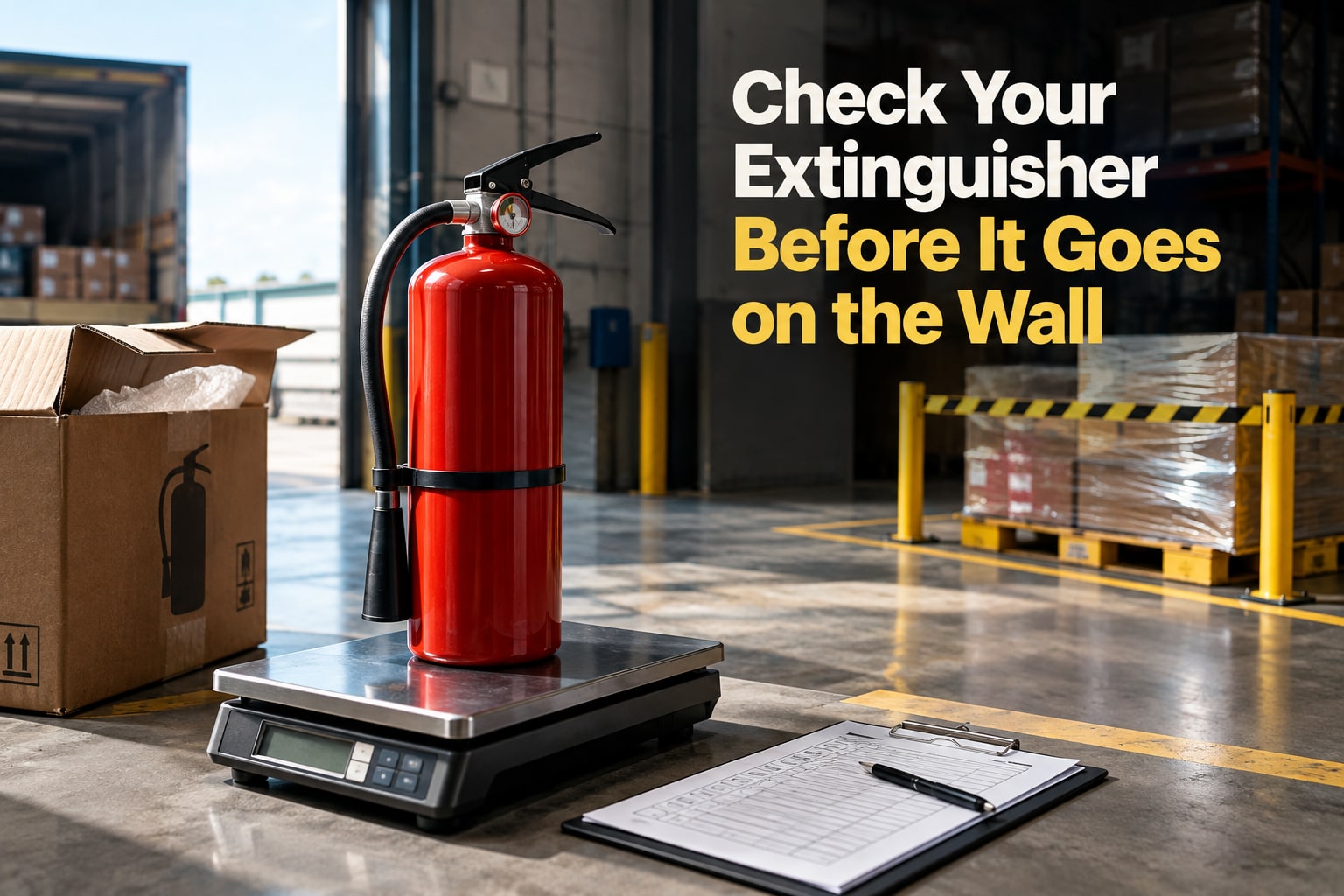
A calibrated scale provides the strongest delivery check for charge quantity. A green gauge shows stored pressure, not whether the cylinder contains the correct 9 kg of ABC powder.
Record these details in the fire extinguisher delivery checklist:
- Receiving date, inspector’s name and delivery location
- Model, ABC dry-chemical specification and nominal net agent charge
- Serial or batch number and manufacture date
- Gauge position, marked gross mass and pressure-test or hydrostatic-test date
- Service status and every supplier service, filling or conformity document supplied
Weigh the complete extinguisher and record the scale reading. Compare it with the marked or certified filled mass, allowing for the cylinder and valve tare stated by the manufacturer.
| Check | What the evidence establishes | Required decision |
|---|---|---|
| Measured gross mass | Whether the filled unit matches its certified mass | Quarantine an unexplained shortfall; investigate with the supplier |
| Gauge in the green zone | Stored pressure only | Do not treat it as proof of powder quantity, powder condition or a clear discharge path |
| Supplier documents | Traceability to the physical unit | Accept documents only when they show the same serial or batch number |
For an ABC 9 kg extinguisher inspection, follow the manufacturer’s instructions for any permitted external handling or agitation. Vibration can compact powder, while moisture can cause caking. Never loosen the valve, open the cylinder or dismantle the unit as a delivery test, and do not top it up on site.
Quarantine defects and create evidence before requesting a resolution
1. Stop the acceptance process and mark the unit “HOLD—DO NOT INSTALL.” Move it to a dry quarantine area away from usable fire equipment. Do not mount, commission or discharge it.
2. Quarantine the extinguisher if the gauge is in the red zone, the safety pin is missing, the tamper seal is broken, the hose or nozzle is blocked, the cylinder is corroded, the gauge lens is cracked, or the label is unreadable. Place it on hold when serial, batch or manufacture details are absent.
The ABC extinguisher condition check also fails for a moisture-damaged carton, wet or contaminated powder, discharge residue, strap abrasion, valve impact or other evidence of a transport drop.
3. Photograph the carton before disposal. Then photograph the full extinguisher, serial plate, gauge, safety pin, tamper seal, label, base and every defect. Record the delivery date, purchase-order line, measured gross mass and inspector’s finding, including the allocated quarantine location and responsible inspector.
4. Send the photographs and a written defect list to the supplier. Request replacement or a written resolution before installation. Do not authorise a local workshop to straighten, repaint, recharge or repair a pressure-vessel defect without the manufacturer or an authorised service agency. Keep the rejected unit segregated until its disposition is documented.
Complete the Hosur site check before mounting or accepting for service
Product acceptance does not commission the extinguisher. For an ABC 9 kg fire extinguisher for inspection after delivery in Hosur, confirm the planned location and hazard before authorising service.
1. Match the location to the fire risk and the site fire plan. An ABC unit is not a substitute for equipment rated for burning metals, cooking oils or specific energised-electrical risks. Apply IS 2190, the manufacturer’s instructions and site fire-safety requirements.
2. Check visibility, access, signage and travel distance from the protected work area. Keep the unit clear of stored materials, direct sun, rain, chemical splash and dust that could enter the hose or nozzle.
3. Confirm vehicle and forklift protection without blocking the handle, hose, nozzle or removal path. Do not place the extinguisher over a heat source or where escaping powder would be obstructed.
4. Inspect the specified bracket, fasteners and supporting surface before mounting. The hardware must carry the extinguisher securely and remain tight under site vibration.
5. Record the allocated location, responsible inspector, acceptance decision and photographs. For industrial extinguisher checks in Hosur, assess that site’s heat, dust, chemical and outdoor-storage exposure rather than copying another premises’ arrangement.
6. Treat a failed delivery as unresolved: Prestige Industrial Suppliers can confirm documents or arrange a resolution before installation. After acceptance and commissioning, add the unit to the site’s inspection, maintenance, recharge and hydrostatic-testing programme. Keep the receiving record with the buyer.
Related product
 | FIRE EXTINGUISHER Prestige Industrial Suppliers is recognized as one of the best Fire Extinguisher dealers, offering top-quality fire safety solutions for industrial,... View product → |
Frequently asked questions
What should you inspect first after an ABC 9 kg extinguisher arrives?
Photograph crushed corners, torn strapping, wet patches, powder residue and punctures before opening the carton. Then confirm the model, 9 kg fill size and delivery records.
Which external components need an ABC 9 kg extinguisher inspection?
Inspect the cylinder, valve, pressure gauge, hose, nozzle, safety pin, tamper seal, handle, label, mounting bracket and base for damage or missing parts.
Can the pressure gauge confirm that an ABC 9 kg extinguisher is correctly filled?
No. The gauge shows pressure, not powder quantity. Compare the extinguisher’s measured weight with its recorded filled weight and inspect service records.
What should you do when a fire extinguisher arrives damaged?
Quarantine it, prevent mounting or service use, photograph each defect, record carton and extinguisher details, and request a documented resolution from the supplier.