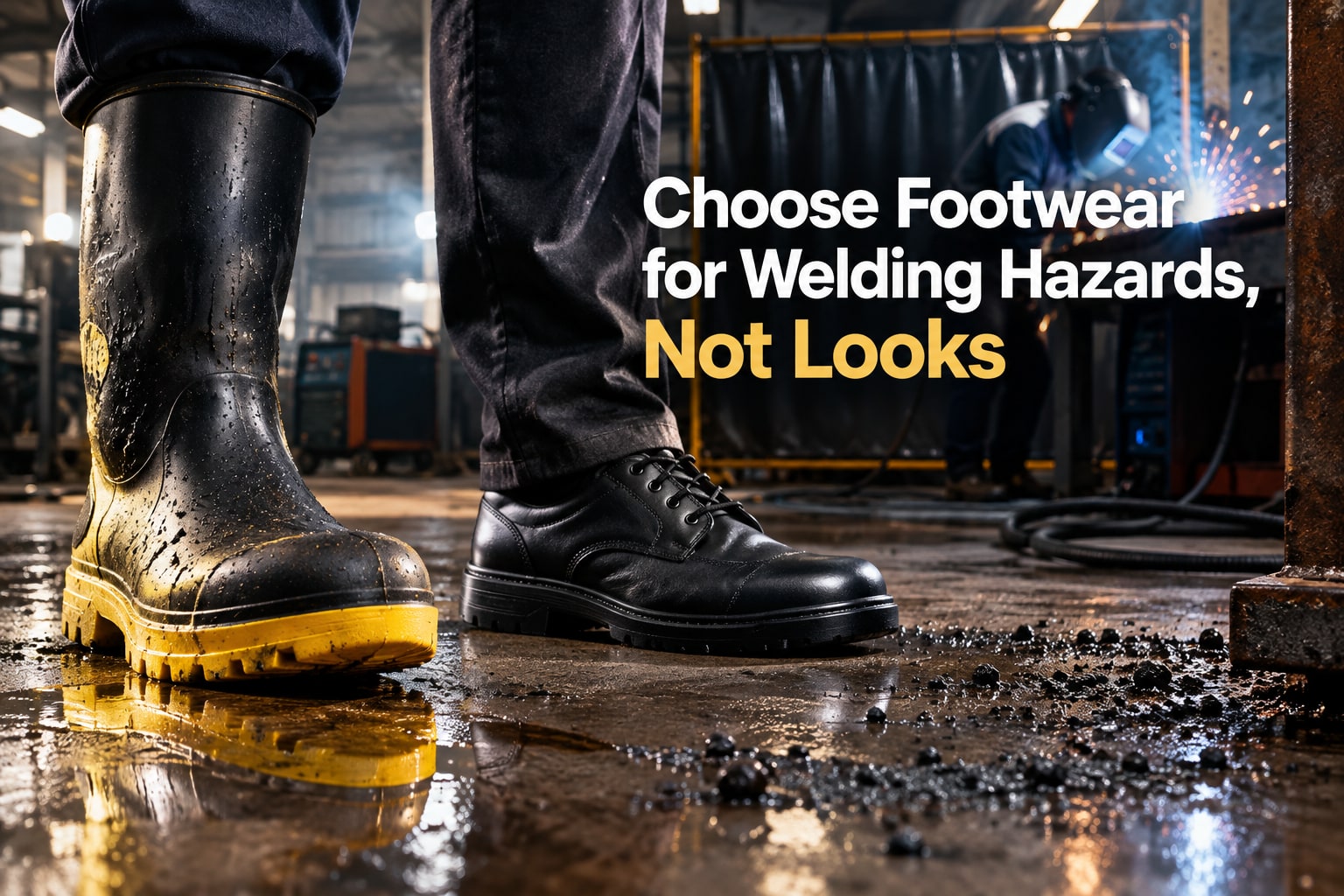
A low-ankle executive shoe and a yellow-sole steel-toe gumboot solve different parts of a welding job: one prioritises movement on a dry fabrication floor, while the other can contain water, mud and debris around the lower leg. By comparing exposure, test evidence, fit and upkeep, you can issue the construction that matches each welding station instead of treating colour or toe protection as proof of welding protection.
Key takeaways
- Use executive shoes on dry, controlled indoor floors with limited splash.
- Choose high-shaft gumboots for wet, outdoor or debris-heavy welding zones.
- Ask for evidence covering heat, molten-metal splash, impact and slip resistance.
- Specify electrical protection, static control, fit tests and replacement triggers separately.
Choose by the welding area, not by appearance
Choose a low-ankle executive-style shoe only on a dry indoor floor where splash is limited and housekeeping is controlled; choose a high-shaft gumboot for wet, outdoor or debris-heavy work zones.
| Option | Best-fit work zone | Main limitation |
|---|---|---|
| Executive-style safety shoe | Dry fabrication floor, limited splash, controlled housekeeping | Leaves the ankle, tongue, laces and upper more exposed to sparks and slag |
| High-shaft gumboot | Wet areas, standing water, outdoor work, hose-down cleaning, mud or grinding debris | Can trap heat, add weight and catch a loose trouser cuff |
Frequent sparks, molten droplets or slag call for a higher-cut design with a close-fitting, spark-resistant closure, not an exposed lace area. A gumboot adds material around the lower leg, but its shaft can catch loose trousers; tuck or secure the trousers outside the hot-work zone without leaving an opening that admits slag.
The phrase executive safety shoes or agarson gumboot yellow sole for welders describes a choice between constructions, not a safety classification. Yellow identifies the sole colour; it does not prove resistance to heat, splash, oil or penetration.
For welding workshop safety footwear, check the boot’s polymer against the actual exposure. PVC, nitrile rubber and natural rubber do not provide interchangeable heat, oil or solvent performance, and a product photograph cannot show whether the shaft, opening or closure contains thermal protection.
Demand evidence for heat, splash, impact and slip hazards
A steel toe proves impact and compression protection; it does not prove resistance to molten-metal splash, radiant heat, hot-surface contact, flame, puncture or slipping. Treat welding workshop safety footwear as a separate evidence decision, whether you are considering an executive shoe or a gumboot.
1. Request the exact model code, toe-cap marking, impact and compression results, penetration-resistance marking, upper and outsole materials, oil-resistance result, slip-test result and conformity documents.
2. For electric-arc welding and allied processes, request evidence against EN ISO 20349-2 when thermal risk and molten-metal splash are part of the exposure. An EN ISO 20345 claim alone does not answer that question.
3. Confirm the tested temperature exposure and method for the complete footwear assembly. The upper, closure, stitching, insole, lining and adhesive must be included; a removable insole or a quoted outsole temperature does not prove that the boot is heat-safe.
4. Match the material to the exposure. PVC, nitrile-rubber and natural-rubber gumboots have different heat, oil and solvent performance, so do not treat them as interchangeable.
5. Reject catalogue-only approval. The phrase agarson yellow sole steel toe gumboot identifies neither a particular Agarson model nor its toe rating, thermal test, slip performance or electrical properties. Obtain the model code, conformity report and production-batch documents before accepting a pair.
Separate electrical protection from static control, then test the fit
Neither option is suitable for electric-shock protection merely because its label says antistatic; arc-welding approval depends on the footwear category and documented electrical limits. Antistatic footwear dissipates electrostatic charge, not welding voltage.
| Option | Electrical meaning | Welding decision |
|---|---|---|
| Executive safety shoe | Antistatic marking controls static charge; it is not insulation | Approve only for documented exposure and electrical limits |
| Agarson yellow sole gumboot | Yellow colour and antistatic marking prove neither insulation nor shock protection | Approve only after the exact model’s evidence is verified |
| Electrically insulating footwear | A separate category with a defined voltage rating and test method | Use only when the rating, inspection interval and limits on use match the task |
For an executive safety shoes fabrication in Hosur enquiry, ask for the defined voltage rating, test method, inspection interval and restrictions on use. Never infer shock protection from an antistatic symbol.
Run a worker trial before bulk issue using normal socks and work trousers:
- Check toe clearance without letting the foot slide forward; the steel toe must not press the toes or instep.
- Walk, kneel, climb, use a ladder and cross an uneven floor. Reject repeated heel lift or pinching during flex.
- For a gumboot, measure shaft circumference over the trousers and reject an opening that gaps around the leg.
- Record the worker’s fit result rather than approving by nominal size alone. That size does not predict comfort or control during a welding shift.
Compare shift comfort, cleaning effort and replacement triggers
For a full shift, a low shoe usually feels lighter and permits easier toe flex and faster removal; a gumboot gives broader lower-leg coverage but can create more heat, weight and sweat fatigue.
| Option | Shift comfort | Cleaning effort |
|---|---|---|
| Low executive-style shoe | Flexes easily and removes quickly, but exposed laces, tongue and low upper collect slag and metal dust. | Remove debris frequently; inspect the lace area, tongue and upper after hot work. |
| Yellow-sole gumboot | Covers more of the lower leg, but shaft height, boot weight and trapped sweat can increase fatigue. | Handles wet-floor cleaning better when its polymer and seams suit the exposure; inspect the shaft and seams for contamination. |
| Both | Poor fit causes pressure, heel movement or rubbing during welding workshop safety footwear use. | Do not rely on an insole or lining to prove that the complete boot is heat-safe. |
Inspect footwear at every shift changeover, not only at day’s end. After debris is safe to handle:
- Brush off slag and sharp metal dust.
- Check the tread for embedded chips and clean contamination from the upper or shaft.
- Stop using the pair if heat cracks the polymer, the sole separates, the tread becomes smooth, the toe cap shifts, leakage appears or the upper develops a hole.
Run a break-in trial before assigning long shifts, record the issue date and batch, and replace footwear when its protective construction or fit fails. A gumboot opening must not admit slag around the trouser leg.
Build a defensible Hosur purchase specification
A defensible Hosur file starts with the quoted model, factory and evidence, not the colour or the phrase “made in Hosur.”
| Option | Approval basis | Reject or hold when |
|---|---|---|
| Executive safety shoe | Exact model and factory are named; documents cover welding hazards and the tested footwear assembly | The quote gives only “executive shoe” or a general safety-footwear claim |
| High-shaft gumboot | Production sample matches the quoted batch and passes incoming inspection | The supplier offers only a catalogue photograph or an unidentified model |
For an executive safety shoes fabrication in Hosur enquiry, request:
- Toe-cap material, impact and compression rating
- Outsole compound, slip result and penetration-resistance result
- Thermal and molten-metal-splash evidence, including the complete assembly’s test method
- Electrical category, batch or lot traceability, warranty terms and replacement process
For yellow sole gumboots in Hosur, request a production sample from the quoted batch. Inspect toe-cap position and clearance, sole-to-upper bonding, heel and shaft symmetry, leakage, outsole hardness, flex cracking and dimensions.
Ask the supplier to identify the catalogue model behind “agarson yellow sole steel toe gumboot.” If the model, test report or electrical classification is absent, record those properties as unverified. A removable insole does not prove heat safety; adhesives, lining and stitching can fail first.
Prestige Industrial Suppliers can help compare available footwear against this specification, while your purchase file retains model documents and the incoming inspection record. Approve the shoe for dry, controlled stations and the gumboot for verified wet or debris-heavy exposure. Neither passes on colour alone.
Frequently asked questions
When should welders choose executive safety shoes instead of yellow-sole gumboots?
Choose low-ankle executive safety shoes for dry indoor floors with controlled housekeeping and limited splash. Choose high-shaft gumboots for wet, outdoor or debris-heavy work zones.
What evidence should you request for welding workshop safety footwear?
Request documented performance evidence for heat exposure, molten-metal splash, toe impact, compression and slip resistance. Check that the evidence applies to the exact model and construction you will buy.
Are electrical protection and static control the same thing?
No. Electrical protection limits current flow during electrical contact, while static-control footwear dissipates electrostatic charge under specified test conditions. Treat them as separate requirements and verify each one.
How should you compare footwear for a full welding shift?
Compare ankle and shaft support, toe-box space, sole flexibility, heat retention, cleaning time and drying time. Replace footwear when the sole loses traction, the upper splits, the toe cap is exposed or contamination cannot be removed.
What should a Hosur purchase specification include?
Name the exact footwear type, toe protection, sole material, shaft height, heat and splash performance, slip resistance, electrical or static-control requirement, size range, inspection documents and replacement criteria.